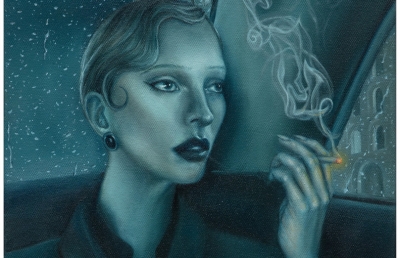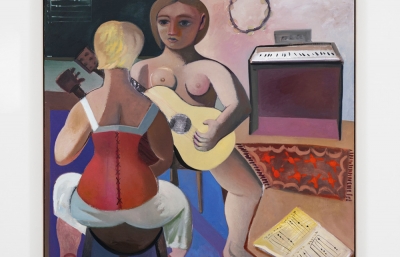


Night Gallery is pleased to present Into the Reflection, an exhibition of new paintings by Miami based artist Farley Aguilar. This marks Aguilar's second solo exhibition with the gallery.

By casting archival images into surreal, fluorescent oils, Aguilar’s paintings recontextualize historical moments and expose their uncanny luridity. While the content of Aguilar's previous work has addressed institutional violence and issues pertaining to social justice, Into the Reflection zooms in. By focusing on a more granular, intimate register, Aguilar’s new paintings examine the solitude and aspiration of subjectivity.
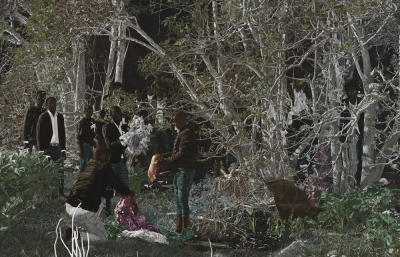
Working from found photographs—here employed less as historical documents than as archetypal domestic scenes—Aguilar introduces anachronistic elements that collapse past and present. A cell phone crops up in a pasture; a woman with blue nail polish gets her hair done in an ostensibly mid-century salon. The juxtaposition raises questions surrounding the evolution of subjectivity, how humanity’s obsession with the self evolves or devolves throughout time.
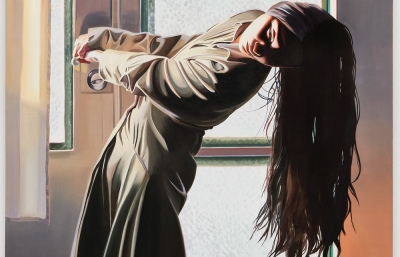
In Snared, a staged hunting photograph from decades past is interrupted by a figure absorbed in her phone. The title's double meaning becomes clear: these animals have been caught, but so too has a generation ensnared by new modes of relating to others and themselves. Transfiguration depicts the aforementioned blue-nailed woman in a salon, his face a chaos of clashing colors as he looks between phone and the mirror, caught in an unstable flux between competing ideals and gazes.
The paintings in Into the Reflection are set primarily in spaces of transformation: beauty salons, vanities, private rooms where the work of self-construction unfolds. Here, mirrors multiply and distort, offering endless opportunities for reflection, visibly setting their subjects ill at ease. Aguilar distinguishes between the objective self—quantifiable, reproducible, commercializable—and the subjective self, cultivated through silence, distance and introspection. In an era of curated personas and algorithmic echo chambers, the objective self aligns with technological ideology: we construct ourselves through what we consume, what we project, what we perform for others to see.
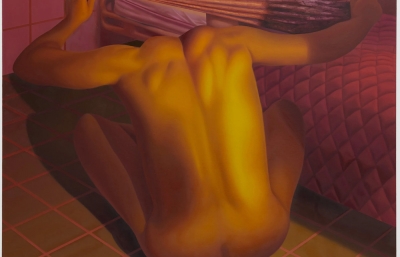
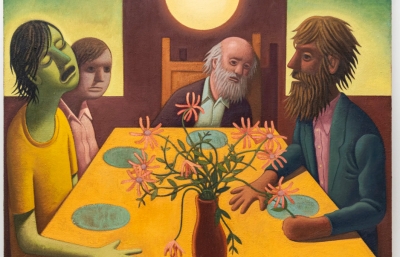
Aguilar's signature use of fluorescent oils remains central to his visual language. Vibrant hues clash and collide across the picture plane, creating a visual tension that mirrors the psychological states depicted. For Aguilar, these chromatic confrontations reflect the perpetual friction between opposing forces—the objective and subjective, the external and internal, the performed and the authentic. This restless energy courses through every canvas, a formal manifestation of the artist's own experience navigating social and technological constraints.
Aguilar frames contemporary beauty practices—filters, plastic surgery, the endless pursuit of an ever-shifting ideal—as attempts to deny mortality and eliminate the idiosyncrasies that mark us as human. In Purification, a woman undergoes a salon treatment rendered as an almost violent act, recalling Nathaniel Hawthorne's "The Birthmark," in which the removal of imperfection destroys the person herself. To erase our genetic particularities, Aguilar suggests, is to erase our humanity.
Into the Reflection proposes that while we've always projected ourselves toward some ideal—proximity to God, membership in the court, conformity to beauty standards—today's technological paradigm creates something more insidious: a closed loop of algorithmic curation and confirmation bias. We construct our realities through filter bubbles and targeted content, seeing only what reinforces our existing views. Despite promises of unlimited information and global connectivity, we remain confined within echo chambers of our own making, where the self becomes both endlessly malleable and rigidly constrained.
With characteristic intensity, Aguilar renders the strangeness of our current moment: the bizarre brutality of constant self-surveillance, the desperation to achieve an ephemeral digital ideal, the violence done to the possibilities of being. His paintings function as portraits of states of mind—singular and collective—in which interiority has become both a refuge and a battleground.